TEL: +86 15587495056

Chemical Pump Recommendations for the Caustic Soda Manufacturing Industry

Chemical Pump Recommendations for the Caustic Soda Manufacturing Industry
The caustic soda manufacturing industry involves a full production workflow that covers brine refining, electrolysis, alkali evaporation, finished product concentration, and the transfer of various corrosive intermediate and waste fluids. The chemical pumps used in this scenario must operate reliably under long-term continuous duty, withstand high concentrations of alkaline media, avoid crystallization blockage, and strictly prevent leakage, to ensure both production safety and stable process efficiency. Below are targeted pump type recommendations and selection guidelines tailored to the core working conditions of the caustic soda sector.
Vertical Chemical Pumps for Alkali Circulation
Vertical chemical pumps are the preferred choice for closed-loop alkali circulation systems in electroplating lines, scrubbers, surface treatment units and caustic soda storage tank circulation loops. They can be directly installed inside tanks or pits, eliminating the need for foot valves, and perform stably even when liquid levels fluctuate frequently.
Core applicable media: Sodium hydroxide solutions with variable concentrations, ammonia-alkali mixed cleaning fluids, and low-temperature alkali wastewater.
Material configuration options: Choose FRPP for medium-concentration alkali at normal temperature, and PVDF for high-concentration, high-temperature caustic fluids to extend service life.
Key advantages: The vertical submerged structure reduces the risk of alkaline liquid leakage, and the modular design allows quick disassembly for routine maintenance without moving the entire pump unit.
Horizontal Fluoroplastic Centrifugal Pumps for Medium-Flow Medium-Head Transfer
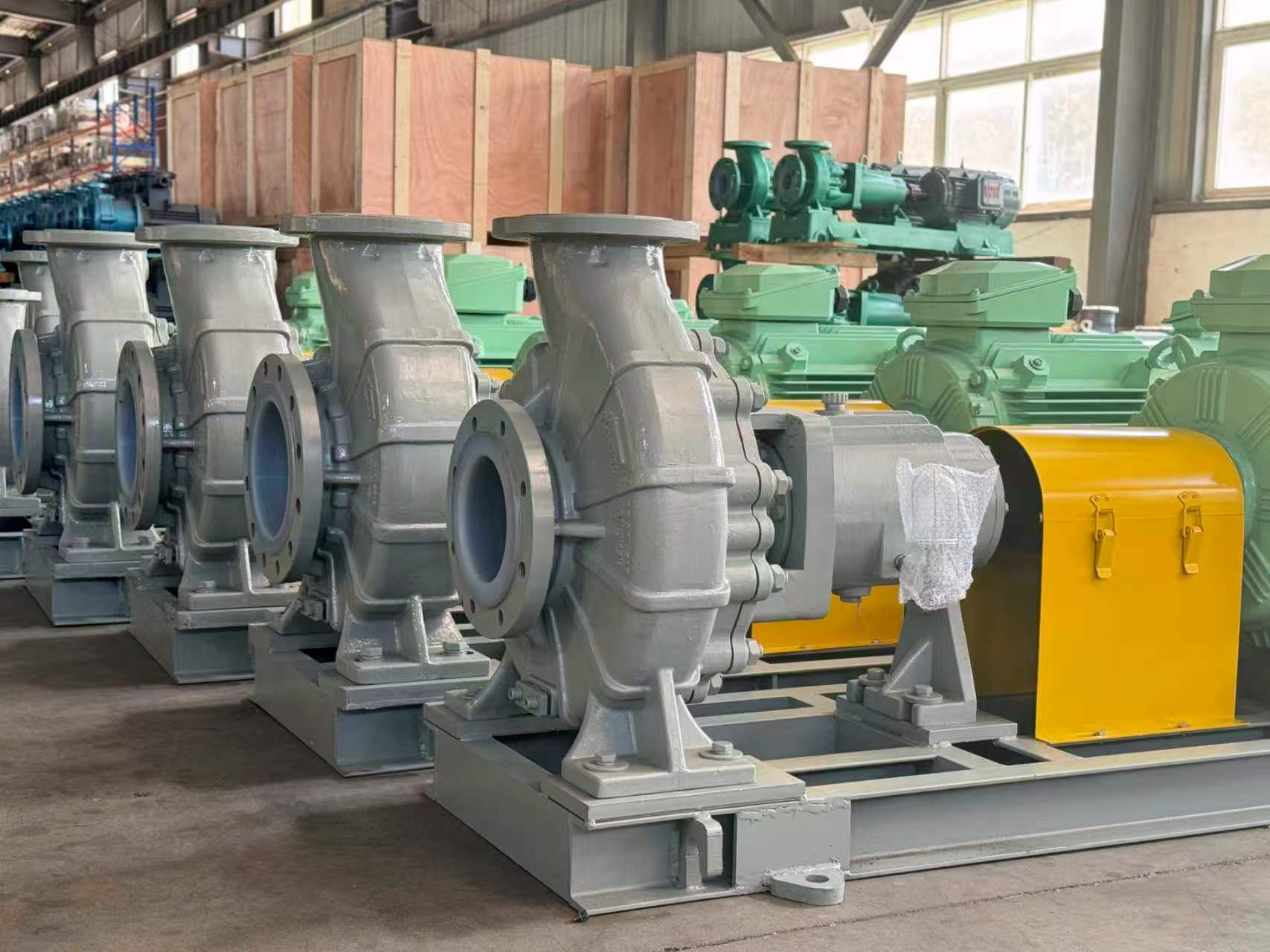
For working conditions with a flow range of 10–100m³/h and head range of 20–50m, such as acid pickling tank circulation and neutralization wastewater transfer in caustic soda plants, horizontal fluoroplastic centrifugal pumps are a highly cost-effective option.
Seal configuration: Use silicon carbide paired mechanical seals for clean alkali fluids; for media with minor crystalline particles, select flushing-type mechanical seals to reduce abrasion on the seal faces.
Practical operation tips: For 24-hour continuous production lines, it is standard practice to deploy one operational pump plus one standby pump, to avoid full-line shutdown caused by a single pump failure. It is also recommended to reduce pipeline elbows to cut down flow resistance, and reserve a 10%–15% head margin to prevent insufficient delivery capacity caused by pipeline aging and scaling.
Specialized Anti-Crystallization Pumps for High-Concentration Caustic Soda
High-concentration caustic soda easily precipitates crystals when the ambient temperature drops, which is most likely to cause blockage and damage in the mechanical seal chamber where fluid volume is small and cools rapidly.
Protection solutions: For outdoor caustic soda pumps in areas where the ambient temperature may drop below 15°C, electric heating jackets with thermal insulation are the minimum required crystallization protection. For intermittent-duty pumps, install an automatic water flush system that activates immediately when the pump stops, to flush residual alkali fluid out of the seal chamber.
Economic benefit: The cost of these anti-crystallization protection measures can be fully recovered after just one avoided unplanned maintenance shutdown.
Barrel Pumps for Fast Alkali Liquid Dispensing
For scenarios that require frequent emptying and sub-packaging of alkali liquid from drums, electric or pneumatic driven barrel pumps are an ideal choice.
Material matching: Select PP pump bodies for medium-corrosion alkali fluids, and PVDF or PTFE wetted parts for strong corrosive, high-concentration caustic soda.
Functional highlights: Modern models feature a seal-free design, support adjustable speed and overload protection, and can be directly fixed on the drum mouth for hands-free operation. For explosion-proof areas, pneumatic drive versions are recommended to eliminate electrical safety risks.
Selection Principles Before Procurement
Before finalizing any pump model, confirm full parameters including the exact name, concentration, temperature, viscosity and solids content of the conveyed alkali medium, as well as required flow rate, head, tank depth and daily continuous operation hours. For special media such as ammonia-containing waste alkali, independent pipelines should be arranged to prevent exothermic reactions with accidental mixed acid fluids, to ensure the long-term safe and stable operation of the entire fluid handling system.